June 25, 2026
Why Everyone in Tech Talks the Same Way
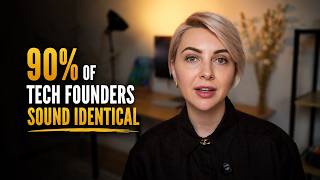
Why does everyone in tech talk the same way? "gm," "we're so early," "founder mode" — it's a dialect that shapes what you believe. I break down how tech buzzwords work and who benefits from them.
Key Takeaways
- —How tech buzzwords work
- —How "founder mode" became doctrine in a week
- —Why "wagmi" and "have fun staying poor" are a retention and acquisition engine
- —Why the freedom to mock the dialect is the highest tier of the hierarchy
- —How to stay fluent without getting used by it
Transcript
"We're so early." "Just shipping." "gm." Spend ten minutes in tech and this stops sounding like language and starts sounding like weather.
Today I want to dissect that dialect: where it comes from, what it's quietly doing to your thinking, and why the people who coin the words end up owning more than the words.
I'm Daria Strategy. I work with founders on go-to-market and narrative, turning a product into language a buyer understands. So language is the whole job, and tech's dialect is one of the most efficient persuasion machines I've had to take apart.
Every in-group has a vocabulary, and it's never really about communication. It's a password, and underneath the password is something more valuable: a category. When a market agrees on its words, money starts moving along those words. So the dialect is how an industry decides what it believes, and the people who name the belief tend to capture it.
Watch how fast it moves. A year or two ago Brian Chesky gave a talk, Paul Graham wrote an essay, and "founder mode" went from not existing to being a worldview within a week. Suddenly every founder was in "founder mode," every mediocre decision was justified by it, and a generation of managers were retroactively the villains. That's the speed at which language becomes operating doctrine here. A phrase doesn't describe the conversation. It reorganizes it.
Crypto Twitter is the purest specimen on the internet, so let's live there. "gm." "wagmi" — we're all gonna make it. "ngmi," its cruel little cousin. "ser." "anon." "fren." "few." "probably nothing," dropped under enormous news as a flex of false calm. And my favorite, "have fun staying poor," which is, when you think about it, the most ambitious acquisition strategy ever attempted — a growth funnel built on insulting the people who haven't converted yet.
Look at what that vocabulary does as a system. "gm" is a retention ritual disguised as a greeting. "wagmi" binds your financial hope to the group's. "few understand" hands every insider a badge of secret intelligence. The contempt and the belonging are load-bearing. They're the moat.
Tech Twitter runs the same machinery, buttoned up. "Building in public." "Cracked engineer." "Skill issue." "Based." "No notes." The "hot take," posted directly above an opinion that is, almost always, the consensus. Say "we're so early" and you've signed up to the belief the thing is destined to be huge. Say "skill issue" and you've adopted a whole theory of whose fault problems are. You think you're describing reality. You're being issued a position.
Here's where it sharpens. The dialect isn't only a password, it's a loyalty test, because to speak it fluently you have to wear the beliefs underneath. So when someone breaks the script, the reaction is wildly out of proportion. Reply to a wall of "wagmi" with "statistically, a lot of us are not going to make it," and you haven't just been a downer. You've broken character. You've revealed you might not be a believer, and conviction-based markets smell that instantly. Doubt doesn't read as analysis. It reads as sabotage.
So who gets to refuse it? Two groups. Outsiders who haven't absorbed it, who pay a quiet tax — that flicker of this one doesn't quite get it. And insiders senior enough to opt out: the person established enough to announce "I cannot stand 'building in public'" and have the room receive it as candor rather than cluelessness. Which reveals the real hierarchy: the freedom to mock the password is itself the highest-tier password. You have to be deep inside before you're allowed to roll your eyes at the thing that got you in.
And here's the part with money attached. Every time you repeat one of these phrases, you're doing free distribution for whoever benefits from the belief inside it.
The dialect is a marketing channel the tribe runs on volunteer labor, yours. The people who coined "founder mode," who minted "wagmi," captured the narrative, and narrative is upstream of capital. You're doing unpaid promotion for someone else's worldview and calling it your personality.
I'm not telling you to refuse the language. Some of it is useful shorthand and I use it constantly. I'm telling you to notice the moment a phrase leaves your mouth that you never consciously chose, because that's the moment a belief installed itself without asking. Whose thesis did you just repeat? Who profits when you do? The strongest position isn't speaking the dialect fluently or refusing it on principle. It's being fluent enough to wield it on purpose, and self-aware enough that it never gets to wield you.
Hearing what a phrase makes people believe before they've had a chance to think is the core of what I do as Daria Strategy, finding language for a product that lands with the buyers a founder actually wants. If that's your thing, subscribe.
And tell me: what's the phrase in your timeline you can't stand and still, to your shame, catch yourself using?